There’s a moment, in every agency, when a client stops replying. They don’t leave, they don’t argue: they simply don’t pay and don’t write. Meanwhile their services keep running, because they’re in your name and you’re the one paying for them.
The question that arrives at that point isn’t whether to chase. It’s far more concrete: what do I switch off, when, and what happens when I do. It’s uncomfortable because it mixes a cash question with a relationship question, and because the instinctive answer is almost always the wrong one.
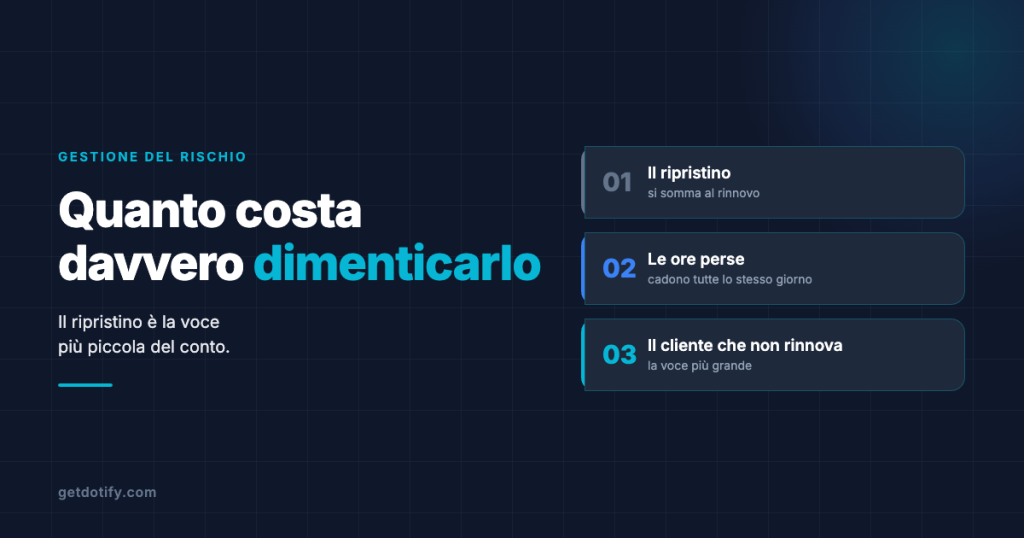
Instinct goes to the domain, because it’s the scariest thing. In money terms it’s the line that matters least. The hard decision is elsewhere, and it sits where the real money is.
By the time you notice, you’ve already fronted the money
The starting point is working out how long you’ve been financing this client. Not since the invoice fell due: since the money left towards the provider. Those are two different dates, and the second almost always comes first.
If the renewal is automatic, the provider charged on the expiry date without asking anyone. You invoiced a few days later. The client had thirty days to pay, then went quiet. Between the money leaving and the moment you ask yourself the question, two or three months may have passed — and in those months the service carried on working perfectly.
That reframes it. You aren’t deciding whether to deliver a service to someone who isn’t paying: you’re deciding how much longer to keep lending them money. Put that way, the decision gets easier.
The three lines don’t weigh the same
Domain, hosting and maintenance all sit on the same line of the quote and in three different worlds in cash terms. A domain costs ten to fifteen euros a year. Hosting sits an order of magnitude above. Annual maintenance sits two orders of magnitude above the domain.
There’s also a difference in kind, and it matters more than the difference in amount. Domain and hosting you buy from someone: there’s a provider, an incoming invoice, a cost that goes out regardless. Maintenance isn’t bought from anyone — it’s your time. Which means suspending it doesn’t recover money already spent, it stops you spending what you’re about to spend.
Hence the sensible sequence, which is the opposite of the instinctive one: start with what costs most and makes least noise, not with what costs least and makes most.
Maintenance is the first lever, not the last
Suspending maintenance is the move nobody thinks of first and almost always the right one to make first. It takes nothing offline, creates no emergency, and doesn’t put you in the position of someone applying pressure. You simply stop working for free.
It does have to be communicated, though, otherwise it isn’t a suspension: it’s abandonment. One line saying that work is on hold pending payment, and that backups and updates resume when billing resumes, is enough. Tone matters: it isn’t a threat, it’s an announced consequence.
There is a side effect and it’s honest to say so: a site left without updates for a few months accumulates risk. It’s worth writing that into the message, because it’s true and because it’s the most effective argument you have for getting paid.
Hosting is the strong lever, and should be used knowing it
Suspending hosting takes the site offline. If the mailboxes sit on the same plan — and very often they do — it kills the email too, at which point the client doesn’t even receive your reminder. It’s a lever that always works and that almost always burns the relationship.
If you use it, use it with written notice and a specific date, and check where the email lives first. In our experience the notice is worth more than the suspension itself: most payments arrive between the announcement and the date, not after. A client who knows what happens on the fifteenth finds a way to pay on the fourteenth.
Watch one detail that gets forgotten: if the client bought something themselves and you only manage part of the stack, suspending what you control can break something you don’t. Knowing who bought what is a precondition, not a detail.
The domain comes last
Letting a domain lapse is the only one of these moves that can do irreversible damage, and the cheapest one to avoid. Which is why it should be treated as the opposite of the other two.
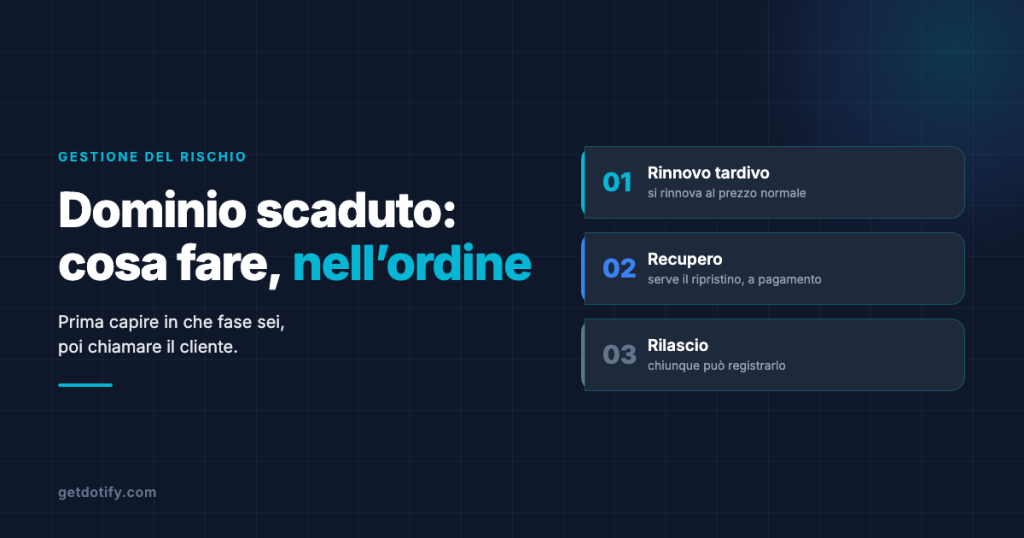
The technical margins help you decide calmly. An .it can be renewed with no surcharge for fifteen days past expiry. Beyond that you enter the thirty-day restore period, which costs roughly twelve euros on top of the renewal. On a .com restoration runs past sixty euros, with real differences between registrars: worth checking your own terms rather than trusting a generic figure. Other extensions have different timings: check the ones for the domain in front of you. The full picture is in what to do when a client’s domain has expired.
The practical conclusion is simple: fifteen euros is not the lever with which you recover a fifteen-hundred-euro debt. Renew the domain, and negotiate on everything else. What getting this wrong actually costs is set out in the cost of an expired domain.
What should you keep fronting?
Not everything should be switched off, and not every slow payer is a client worth losing. There are relationships where fronting the money is part of the service and is paid for elsewhere; there are others where the delay is chronic but the volume justifies the patience.
The difference between a choice and a drift is one thing: knowing how much you’re fronting and for whom. If you have the number, fronting is a legitimate commercial decision. If you don’t, you aren’t deciding anything — and the worst case is discovering at year end that the slow payers are the ones you make the least margin on.
We wrote a separate piece on this, because it’s the sum nobody works out: how much you’re fronting for your clients without realising.
What mistakes get made when a client stops paying?
- Starting with the domain. Maximum relationship damage for minimum financial recovery.
- Switching off without notice. An announced suspension collects; a surprise one produces only a furious phone call and a finished relationship.
- Suspending hosting without checking where the email is. If it’s there, you’ve just removed the channel the client would have used to reply.
- Continuing maintenance “to be fair”. It’s the one line where you’re giving away your own time, and it’s the one people carry on longest.
- Not putting the consequences in writing beforehand. If they were never written down, every suspension looks like retaliation.
- Treating the case as exceptional. It happens regularly. Improvise every time and it costs more than it should every time.
Where do you start when a client stops paying?
- Check how long you’ve been exposed. Find the date the money left towards the provider, not the date of your invoice. That’s the number that decides how long you’re willing to wait.
- List that client’s lines. What you pay, to whom, how much, and what you charge. If a row is missing the second number, you’ve just found it.
- Write the consequences before applying them. One message with the dates: maintenance suspended on this day, hosting on that one, domain renewed regardless.
- Stop maintenance first. It costs you the most and the client the least, and it’s the move that burns nothing.
- Renew the domain anyway. You’ll recover fifteen euros; you won’t recover a domain lost in redemption.
- Make the terms standard. If the same rules apply to everyone and are written at the start of the relationship, next time you aren’t improvising. We compared keeping them in a spreadsheet against keeping them in a tool in the comparison between a spreadsheet and a real deadline tracker.
How do we handle non-payment ourselves?
Dotify is the tool we use at EnneStudio, our web agency in Padua. It’s ours, so judge accordingly.
For this particular case it does two things. First, it shows every deadline for one client in one place with amount, provider and status, so the conversation starts from a list rather than from memory. Second, payments in and costs to the provider sit on the same deadlines, so what that client still owes you shows up in the awaiting-payment list instead of being reconstructed afterwards. How clients and deadlines are organised is in the documentation.
The free plan holds five clients with three deadlines each, and the emails go out from our servers rather than your own domain: it’s there to show you how the thing works. To watch a reminder arrive under your own logo there’s the fourteen-day trial, no card required. Plans start at €7.99 a month.
The full cycle — notifying, collecting, measuring — is set out in collecting client renewals.